Key insights from McKinsey’s State of Fashion 2026
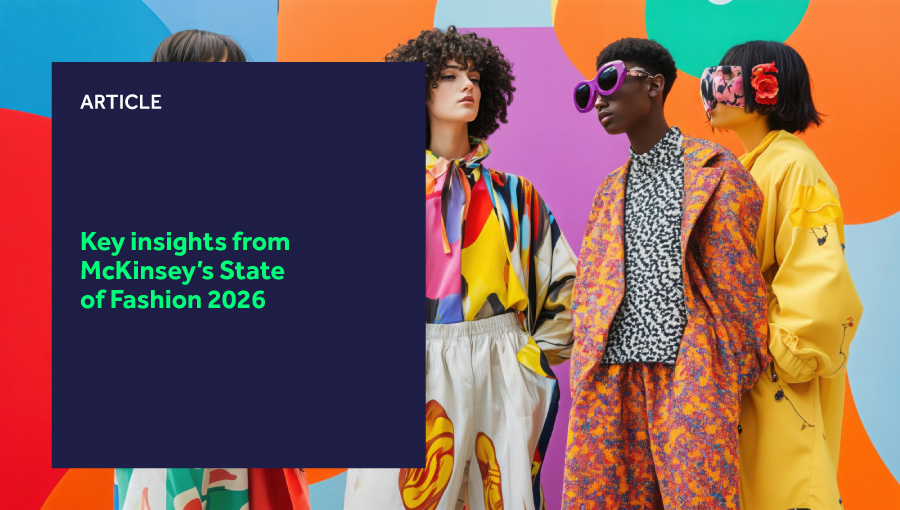
Each year, McKinsey and the Business of Fashion collaborate on the State of Fashion report, which sets the tone for what the industry should prepare for. The 2026 edition paints a picture of a sector under pressure, yet crucially still moving forward.
Cost volatility, shifting sourcing patterns, and rising expectations from consumers all feature heavily. There is also renewed urgency around data foundations and the role of AI.
For fashion, the headline is simple enough.
The coming year will reward those who strengthen their operational backbone, understand where demand is heading, and better manage their product, supply, data, and people.
Amid the themes covered below, there are a few broader trends worth calling out:
With those out of the way, here are what we view as the biggest themes from The State of Fashion 2026.
It should come as no surprise that tariffs still dominate fashion discourse, especially for those companies selling into the US.
The report highlights how duties rose sharply through 2025 and remain well above historical levels. The impact is pronounced across the value chain, with brands reassessing their pricing architectures, suppliers negotiating new terms, and sourcing teams widening their lens.
Cambodia has emerged as a new sourcing hub in large part due to its favourable trade conditions and young workforce.
China’s reduced share of US apparel imports, down around a third since 2019, reflects the broader trend of rebalancing supply chain footprints, rather than a short-term reaction.
Some manufacturers are now spreading capacity between multiple regions, including Africa, to reduce exposure to future supply chain shocks.
We all hate buzzwords, and while efficiency is undoubtedly one of them, there’s no getting away from the fact that amid cost pressures and turbulent trade landscapes, looking inward and bolstering efficiency is a top consideration.
Many have come to realise that the old advantages like scale and low-cost sourcing are no longer sufficient to sustain a healthy economic model.
By leveraging new tech, businesses can reduce costs and improve productivity to unlock new resources to invest in differentiators that spur growth.
One persistent challenge that continues to plague brands is leftover inventory.
Legislation arriving in 2026 will tighten the rules further, particularly in Europe and California, and amplify this pain, since unsold stock and take-back requirements will carry real financial consequences.
The report points to a renewed push to simplify assortments – perhaps best exemplified by Adidas’ turnaround over the last few years – and reducing working capital tied up in stock.
Companies are beginning to adopt more disciplined approaches to forecasting and product creation, supported by digital tools that help them understand how and where value leaks.
While every brand will take its own approach, a clearer focus on productivity is non-negotiable.
Executives see AI as the single most significant opportunity for 2026, but there is a glaring problem. Up to 90% of AI initiatives fail to scale beyond the pilot phase, predominantly because the underlying tech and data are poor and insufficient to support such programmes.
Here is where we see fashion’s long timeline of legacy solutions showing its limitations. Without shared structures, it becomes difficult to move from experimentation to scale.
Nevertheless, momentum is building. Automation of tasks like sampling, image generation, customer service and sourcing analysis is reducing costs and lead times for early adopters.
The more transformative potential, however, lies upstream.
When design, sourcing, planning and commerce are joined by common data, AI can support scenario modelling, capacity decisions and better product performance.
If anything, the observations and trends around AI highlight the fundamental principle that tech, people, and processes must work together for true outcomes to be realised.
A growing share of consumers now use gen AI during their shopping journeys. AI assistants influence product discovery, and, in some cases, purchases. In fact, just over half (53%) of US consumers who used AI for search in Q2 2025 also used it to help them shop.
This shift again carries real implications for the industry and will only become more significant now that OpenAI and Shopify have partnered.
AI surfaces products it can understand, which places more weight on structured attributes and clean metadata for search. That doesn’t mean brands should reduce storytelling and other key marketing tactics, though, since discovery will still take place outside of LLMs.
The key here is that brands must ensure their product information is consistent, complete and easily interpreted by the likes of ChatGPT, Claude, Gemini, and Grok.
Perhaps most interesting is the fact that over 40% of consumers said AI responses felt more reliable than paid ads, while only 15% considered them less reliable. This reinforces the point that optimising product listings for AI will be essential going forward.
The second-hand fashion and luxury market is forecast to grow two to three times faster than the first-hand market through to 2027 as consumer appetite grows for resale.
According to ThredUp, nearly 60% of global consumers say they will seek more affordable options – like resale – if tariffs continue to increase apparel prices. This figure will likely hold true in 2026 as many companies noted to McKinsey that they will indeed raise prices further.
While economic pressures do play a pivotal role in this trend, affordability seems to be just one motivation behind the growing desire for second-hand items.
Many shoppers reported enjoying the search for unique pieces, and resale has become a new source of customers for brands.
Additionally, categories like watches, jewellery, and bags remain particularly strong due to their investment potential.
Operational challenges do persist here, though. From authentication to reverse logistics, there are many considerations that must be resolved, but the overall direction of travel is consistent.
As platforms reach profitability and scale, more brands will reconsider how resale fits into their ecosystem, whether through strategic partnerships or more integrated models.
Jewellery stands out as one of the quickest-growing categories in the report, with unit sales expected to grow 4.1% annually between 2025 and 2028.
(For reference, that is four times the rate of clothing.)
Branded jewellery, in particular, continues to gain share, supported by consumers who view it as both an emotional and an investment piece.
Elsewhere, lab-grown diamonds have expanded quickly in major markets and are projected to account for a significant share of unit sales by the end of the decade.
This represents a huge step forward in offering more sustainable pieces, but it also reinforces the value of actual jewels and gemstones as status signals, which will help brands maintain their pricing positions as lab-grown alternatives will likely become cheaper as a result.
Growth in jewellery does bring its own challenges, though. These items carry higher attribute density, stronger traceability requirements and more detailed product histories.
Those that succeed will be the ones who manage these layers cleanly and present compelling stories around design, craft and provenance.
One of the more interesting discussions centred on wearables, or more specifically, smart eyewear. Continued investment from tech companies, coupled with more refined designs, is drawing attention back to the category.
Fashion brands have an opportunity to shape the next wave of products through licensing, partnerships or capsule releases.
These items introduce new supply, testing, and compliance demands, often involving more intricate bills of materials. The path from concept to shelf also becomes more involved.
Brands entering the space will need to select strategic partnerships with tech companies and keep each party’s role clearly defined. Furthermore, the broader space will need clear oversight of development, sourcing and production to maintain quality and pace.
All in all, The State of Fashion 2026 describes an industry managing volatility while preparing for a more tech-centred future. Tariffs, costs and consumer behaviour continue to force shifts.
Categories with strong emotional pull – like jewellery, handbags, athleisure – will continue to dominate. Simultaneously, digital commerce is undergoing its next wave of change, this time driven not by social platforms but by AI agents and LLMs.
We’ll also continue to see luxury reinvent itself with a fresh wave of creative directors, while global sourcing patterns change due to structural forces and trade landscapes.
Across all of this sits a common thread. Fashion is trying to simplify wherever it can and manage complexity wherever it cannot. The most resilient players will be those that invest in clean data, simple processes and stronger visibility across products and the supply chain.
The coming year will test how well the industry can combine these elements into a coherent whole.
 https://k3fashionsolutions.com/wp-content/uploads/2025/11/exception-economy-featured.jpg
510
900
Jordan Heal
https://k3fashionsolutions.com/wp-content/uploads/2024/12/K3_Fashion_Solutions_Half-color_RGB.svg
Jordan Heal2025-11-25 09:41:202025-11-25 09:41:20The exception economy: Why order allocation in fashion keeps breaking
https://k3fashionsolutions.com/wp-content/uploads/2025/11/exception-economy-featured.jpg
510
900
Jordan Heal
https://k3fashionsolutions.com/wp-content/uploads/2024/12/K3_Fashion_Solutions_Half-color_RGB.svg
Jordan Heal2025-11-25 09:41:202025-11-25 09:41:20The exception economy: Why order allocation in fashion keeps breaking https://k3fashionsolutions.com/wp-content/uploads/2025/11/jewellery-featured.jpg
510
900
Jordan Heal
https://k3fashionsolutions.com/wp-content/uploads/2024/12/K3_Fashion_Solutions_Half-color_RGB.svg
Jordan Heal2025-11-21 13:17:352025-11-21 13:17:35The jewellery boom: What rising demand means behind the scenes
https://k3fashionsolutions.com/wp-content/uploads/2025/11/jewellery-featured.jpg
510
900
Jordan Heal
https://k3fashionsolutions.com/wp-content/uploads/2024/12/K3_Fashion_Solutions_Half-color_RGB.svg
Jordan Heal2025-11-21 13:17:352025-11-21 13:17:35The jewellery boom: What rising demand means behind the scenes https://k3fashionsolutions.com/wp-content/uploads/2025/11/state-of-fashion-2026-featured.jpg
510
900
Jordan Heal
https://k3fashionsolutions.com/wp-content/uploads/2024/12/K3_Fashion_Solutions_Half-color_RGB.svg
Jordan Heal2025-11-20 11:20:502025-11-20 11:20:50Key insights from McKinsey’s State of Fashion 2026
https://k3fashionsolutions.com/wp-content/uploads/2025/11/state-of-fashion-2026-featured.jpg
510
900
Jordan Heal
https://k3fashionsolutions.com/wp-content/uploads/2024/12/K3_Fashion_Solutions_Half-color_RGB.svg
Jordan Heal2025-11-20 11:20:502025-11-20 11:20:50Key insights from McKinsey’s State of Fashion 2026
Solutions
Resources
Customers
About Us