The exception economy: Why order allocation in fashion keeps breaking
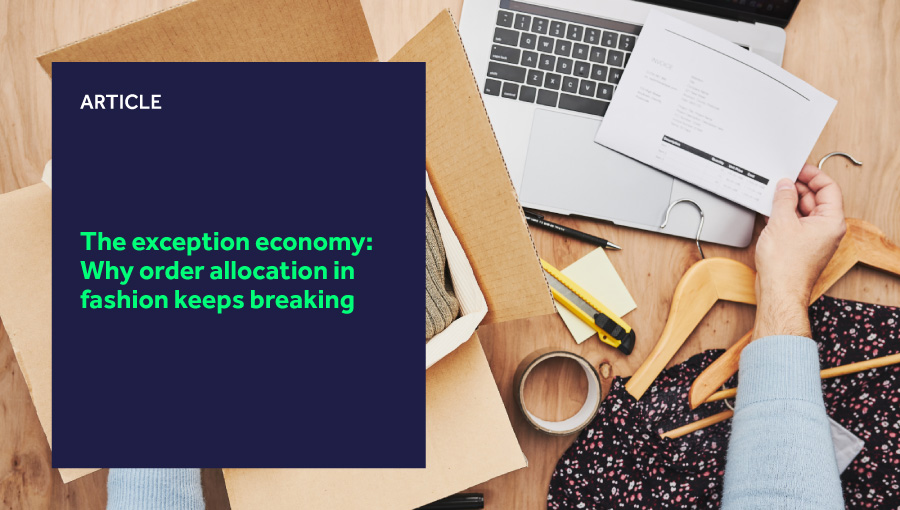
It’s 9:12am. The inbound schedule collapses. A supplier in Turkey has pushed a shipment back by several days. One of the brand’s biggest wholesale partners has asked for its allocation to be brought forward, with no room for negotiation.
Elsewhere, a new store opening has been confirmed for next week (rather than next month), while eCommerce is still waiting for stock that was promised yesterday. Customer service has escalated a replacement request for a VIP client, and several orders have changed overnight.
These are not isolated anecdotes, but the everyday reality of fashion allocation.
With scale comes volume, and that breeds its own set of challenges. While allocation could once be managed in a spreadsheet, the sheer number of orders, changes, and exceptions has created an environment where teams are working at full tilt and hoping nothing slips.
As fashion inches further into what can only be called the exception economy, it’s clear the systems of old have frayed, and a new model of allocation is needed.
Allocation is a simple concept in theory. Inventory flows in, orders are matched, quantities are distributed, and the business moves on to the next collection. In practice, though, the process bends under the weight of variables that could shift with each hour.
At enterprise scale, future orders must be pre-reserved against inbound stock while ringfencing quantities for key accounts. These commitments cannot be breached without risking penalties or damaging relationships.
At the same time, colourways and size curves are often updated late in the process, and customer-level changes ripple through systems with little warning. Teams must decide which channel receives scarce inventory and which one waits.
None of it aligns neatly, nor does it pause while they figure it out.
Even the supporting systems are rarely aligned. Product and SKU information sits across spreadsheets, PLM platforms, warehouse systems, buying tools and legacy processes that have been in place for years.
Allocators are left stitching together pieces of the puzzle, often with incomplete or outdated information. The gap between what the process looks like in theory and how it behaves in practice has grown wider than many executives realise.
No longer can allocation be treated solely as a planning exercise but as a constant triage, supported by systems and processes that understand exceptions are the norm.
The exception economy didn’t happen by accident. It came to fruition through the structural shifts that have reshaped the fashion operating model. The first of which is volume.
Today, brands manage tens, if not hundreds, of thousands of purchase orders, sales orders, drops, capsules, and micro-collections. The number of parallel flows has expanded, and each one introduces more data, more touchpoints and more opportunities for inconsistency and error.
The second shift is variability. Inbound deliveries shift frequently, and even a slight delay in production – be that poorly written techpacks or supply shortages – can disrupt entire allocation plans. Paired with increased volume, it’s easy to see how instability compounds quickly.
Subsequently, teams have to constantly stay reactive and rebuild their plans based on the most current information available to them. Fluidity has effectively been priced into the job.
A third shift is rooted in the rise of priority accounts, particularly in wholesale. Partners expect consistency, key accounts expect protection, and flagship stores expect newness.
To meet those expectations, teams must ringfence stock, hold back specific quantities and commit future inventory to partners before it has physically arrived. These layers add nuance but also generate operational tension.
Channel management provides yet another dimension. Retail demands coverage, eCommerce demands availability and wholesale demands reliability. When stock is tight, the allocator’s desk becomes the negotiation table where these competing expectations meet.
Finally, we have data fragmentation, which is perhaps the most persistent root cause.
When data is scattered across systems and locations, there is no single source of truth for product attributes, reservations, or available stock.
Small mismatches then become large exceptions, leaving people to reconcile the differences.
Behind the numbers lies a more subtle pressure, that being the cognitive load on allocation teams. Allocation is often viewed as a technical function, governed by rules and processes, but in reality, it is a deeply human one.
Every exception demands attention and judgement. Every delay creates a ripple effect that must be understood and managed. Every conflict between channels or customers asks allocators to choose who wins and who waits.
In an ideal world, teams want to focus solely on the exceptions that matter most. Instead, they find themselves trapped in a vortex of noise, reconciling spreadsheets, checking mismatched data, tracing missing updates and answering queries that shouldn’t exist in the first place.
The hidden cost here is fatigue that inevitably shows up in outcomes. Overselling becomes more likely when reservation logic is unclear or when data is outdated.
Misallocations stem from timing gaps between systems and processes. It’s not uncommon to see:
Each of these outcomes may look isolated, but they are symptomatic of a system or process overloaded by exceptions with no clear way to triage them.
Despite the strain, something is beginning to change. Brands that once held tightly to their unique, often idiosyncratic allocation processes are now moving toward more standardised approaches.
While every brand treats allocation differently, there are underlying principles and overlaps that can be streamlined. Teams want fewer manual decisions, clearer product data and simpler reservation logic.
The idea isn’t to eliminate exceptions, though. Flexibility is essential in allocation.
There will always be a need to bend for key accounts, protect future stock and adapt to shifting priorities.
The solution is to use a system with standardised processes that respects that exceptions are part and parcel of modern fashion operations. They allow brands to cut through the noise, triage based on priority, and only intervene on the exceptions that truly demand their attention.
It’s essential to recognise that the exception economy is not temporary. Fashion’s operating environment will continue to become more convoluted as more channels compete for attention, more collections overlap, and more personalisation is promised to customers.
This means more pressure will sit downstream in fulfilment.
Equally, it’s vital to understand that exceptions themselves are not the problem. They will always exist in fashion. The real issue is the proportion of exceptions that add value versus the proportion that come from noise, like unclear data, fragmented systems and legacy processes.
Successful brands will treat allocation as a strategic imperative and invest in the foundations that reduce unnecessary headaches so their teams can focus on the meaningful exceptions.
Fashion itself may never run out of exceptions, but it can choose how many it creates for itself.
Recognise this pain in your own organisation? We’d be happy to talk. Feel free to drop us a line today to learn more about how we can support your allocation goals.
 https://k3fashionsolutions.com/wp-content/uploads/2025/11/exception-economy-featured.jpg
510
900
Jordan Heal
https://k3fashionsolutions.com/wp-content/uploads/2024/12/K3_Fashion_Solutions_Half-color_RGB.svg
Jordan Heal2025-11-25 09:41:202025-11-25 09:41:20The exception economy: Why order allocation in fashion keeps breaking
https://k3fashionsolutions.com/wp-content/uploads/2025/11/exception-economy-featured.jpg
510
900
Jordan Heal
https://k3fashionsolutions.com/wp-content/uploads/2024/12/K3_Fashion_Solutions_Half-color_RGB.svg
Jordan Heal2025-11-25 09:41:202025-11-25 09:41:20The exception economy: Why order allocation in fashion keeps breaking https://k3fashionsolutions.com/wp-content/uploads/2025/11/jewellery-featured.jpg
510
900
Jordan Heal
https://k3fashionsolutions.com/wp-content/uploads/2024/12/K3_Fashion_Solutions_Half-color_RGB.svg
Jordan Heal2025-11-21 13:17:352025-11-21 13:17:35The jewellery boom: What rising demand means behind the scenes
https://k3fashionsolutions.com/wp-content/uploads/2025/11/jewellery-featured.jpg
510
900
Jordan Heal
https://k3fashionsolutions.com/wp-content/uploads/2024/12/K3_Fashion_Solutions_Half-color_RGB.svg
Jordan Heal2025-11-21 13:17:352025-11-21 13:17:35The jewellery boom: What rising demand means behind the scenes https://k3fashionsolutions.com/wp-content/uploads/2025/11/state-of-fashion-2026-featured.jpg
510
900
Jordan Heal
https://k3fashionsolutions.com/wp-content/uploads/2024/12/K3_Fashion_Solutions_Half-color_RGB.svg
Jordan Heal2025-11-20 11:20:502025-11-20 11:20:50Key insights from McKinsey’s State of Fashion 2026
https://k3fashionsolutions.com/wp-content/uploads/2025/11/state-of-fashion-2026-featured.jpg
510
900
Jordan Heal
https://k3fashionsolutions.com/wp-content/uploads/2024/12/K3_Fashion_Solutions_Half-color_RGB.svg
Jordan Heal2025-11-20 11:20:502025-11-20 11:20:50Key insights from McKinsey’s State of Fashion 2026
Solutions
Resources
Customers
About Us