The jewellery boom: What rising demand means behind the scenes
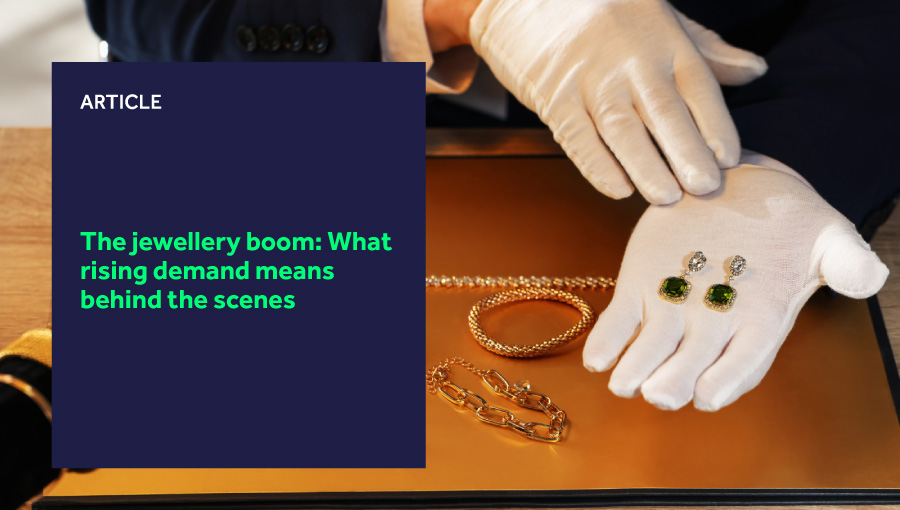
With jewellery’s surge comes the operational thud of reality. While the sparkle of growth is easy to see, the hard work behind the scenes to fulfil that demand is not.
McKinsey’s State of Fashion 2026 reveals that unit sales are set to grow by 4.1% per year between 2025 and 2028, roughly four times the rate of clothing sales.
Branded jewellery is stretching ahead even faster, growing almost twice as quickly as unbranded pieces and now making up approximately a quarter of the global market.
The category has pushed through the wider luxury slowdown. Shoppers still invest when the piece carries meaning, whether for resale potential, to show off their identity, or as a treat.
Buying behaviour is also shifting, with jewellery no longer being held back mainly for gifts.
McKinsey notes that 42% of women and 35% of men now buy more for themselves than two or three years ago. Simultaneously, lab-grown diamonds are expanding at 15-16% a year in major markets like India, China and the US, and will account for half of all diamond jewellery by 2030.
Jewellery is viewed by consumers as both an emotional object, pieces for self-expression and indulgence, as well as investment pieces because they typically hold their prices well.
This combination makes the category a natural entry point for aspirational customers who feel priced out of other parts of the luxury market or are just starting to dip their toes in.
The same behaviour is emerging in adjacent categories, as second-hand bags and accessories become an accessible entry point to brands that sit out of reach at full price.
Because of this, we’re seeing more brands offering jewellery and other accessories at affordable prices to attract new customers.
McKinsey also referenced De Beers’ data that showed India is overtaking China as the world’s second-largest diamond market, behind the US, with 11% of total demand.
India’s rising middle class and cultural affinity for gold and diamonds are fuelling sustained double-digit growth for domestic jewellers.
This signals a significant opportunity for brands to capitalise on growing markets, not only in their traditional territories but in new regions too. That said, challenges will persist.
Jewellery’s expansion is undeniably positive, but it does bring practical demands. More units require more design, sourcing, production, storage and movement.
In a category defined by detail, complexity multiplies quickly.
A single piece may involve multiple metals, stones and finishes, each with its own sourcing requirements, cost profile and compliance rules. Settings, sizes and colourways add further layers to this. Diamond pieces also require precise documentation and quality checks.
At the same time, lab-grown lines introduce parallel specifications. Multi-region brands must also navigate differing regulations and customer expectations.
Jewellery’s growing role in personal identity breeds new challenges too, since broader assortments, genderless ranges and men’s collections increase SKU counts.
For those entering jewellery from adjacent categories, integrating these structures into existing operations becomes a challenge in its own right.
Most of the friction sits behind the scenes. Brands must track compositions, measurements, certifications and care details for every piece. Product hierarchies need to mirror how jewellery is actually bought and sold, not just how designers structure collections.
Inventory, likewise, presents its own difficulties. Jewellery is small yet high in value, which magnifies the consequences of misallocation or inaccuracies. Teams want to reserve pieces for specific customers, channels or regions, while protecting key accounts and avoiding overselling.
As units increase, exceptions become more and more routine. Orders move, stores open or close, customer needs shift, and launch calendars change. Teams want to focus on the unusual cases that matter, not thousands of routine movements. That becomes harder when product data sits across several systems and there is no single way to steer stock with confidence.
This is where an ERP built for fashion (and all its subcategories) becomes valuable for jewellery players. The aim is not to add layers of process, but to create the structures that keep growth manageable.
K3 Fashion, embedded in Microsoft Dynamics 365 Finance, Supply Chain Management and Commerce, supports the full journey from planning and design through to sourcing, manufacturing, order management and retail.
It includes fashion-specific item structures, matrices, variant management and product hierarchies, which help teams manage sizes, colours and fits within a single framework rather than at the lowest level.
For jewellery, that structure supports detailed product data management. Compositions, measurements, quality control information and care guidance can all sit in one place, alongside imagery, brand details and variants.
PLM and the PLM Vendor Portal help coordinate collection planning and vendor collaboration, while TechPacks and supporting documents ground development and production in shared information.
Operationally, inventory and warehouse management tools, paired with order management and allocation capabilities, help brands reserve stock, prevent overselling and prioritise the right customers or channels.
Concepts such as ringfencing and consignment, together with capacity checks at order entry, allow for clearer decisions about where high-value items should go.
As jewellery’s momentum builds, the brands that thrive will be those that pair strong creative vision with structured operations. Rising demand does not have to translate into rising disorder.
With clear foundations across product data, inventory, and order flows, jewellery businesses can scale their brightest category without losing control of the details that make it special.
If you’d like to learn more about how we can help you, feel free to contact us today.
 https://k3fashionsolutions.com/wp-content/uploads/2025/11/exception-economy-featured.jpg
510
900
Jordan Heal
https://k3fashionsolutions.com/wp-content/uploads/2024/12/K3_Fashion_Solutions_Half-color_RGB.svg
Jordan Heal2025-11-25 09:41:202025-11-25 09:41:20The exception economy: Why order allocation in fashion keeps breaking
https://k3fashionsolutions.com/wp-content/uploads/2025/11/exception-economy-featured.jpg
510
900
Jordan Heal
https://k3fashionsolutions.com/wp-content/uploads/2024/12/K3_Fashion_Solutions_Half-color_RGB.svg
Jordan Heal2025-11-25 09:41:202025-11-25 09:41:20The exception economy: Why order allocation in fashion keeps breaking https://k3fashionsolutions.com/wp-content/uploads/2025/11/jewellery-featured.jpg
510
900
Jordan Heal
https://k3fashionsolutions.com/wp-content/uploads/2024/12/K3_Fashion_Solutions_Half-color_RGB.svg
Jordan Heal2025-11-21 13:17:352025-11-21 13:17:35The jewellery boom: What rising demand means behind the scenes
https://k3fashionsolutions.com/wp-content/uploads/2025/11/jewellery-featured.jpg
510
900
Jordan Heal
https://k3fashionsolutions.com/wp-content/uploads/2024/12/K3_Fashion_Solutions_Half-color_RGB.svg
Jordan Heal2025-11-21 13:17:352025-11-21 13:17:35The jewellery boom: What rising demand means behind the scenes https://k3fashionsolutions.com/wp-content/uploads/2025/11/state-of-fashion-2026-featured.jpg
510
900
Jordan Heal
https://k3fashionsolutions.com/wp-content/uploads/2024/12/K3_Fashion_Solutions_Half-color_RGB.svg
Jordan Heal2025-11-20 11:20:502025-11-20 11:20:50Key insights from McKinsey’s State of Fashion 2026
https://k3fashionsolutions.com/wp-content/uploads/2025/11/state-of-fashion-2026-featured.jpg
510
900
Jordan Heal
https://k3fashionsolutions.com/wp-content/uploads/2024/12/K3_Fashion_Solutions_Half-color_RGB.svg
Jordan Heal2025-11-20 11:20:502025-11-20 11:20:50Key insights from McKinsey’s State of Fashion 2026
Solutions
Resources
Customers
About Us