Sustainability’s second wind: Why fashion’s return to responsibility feels different
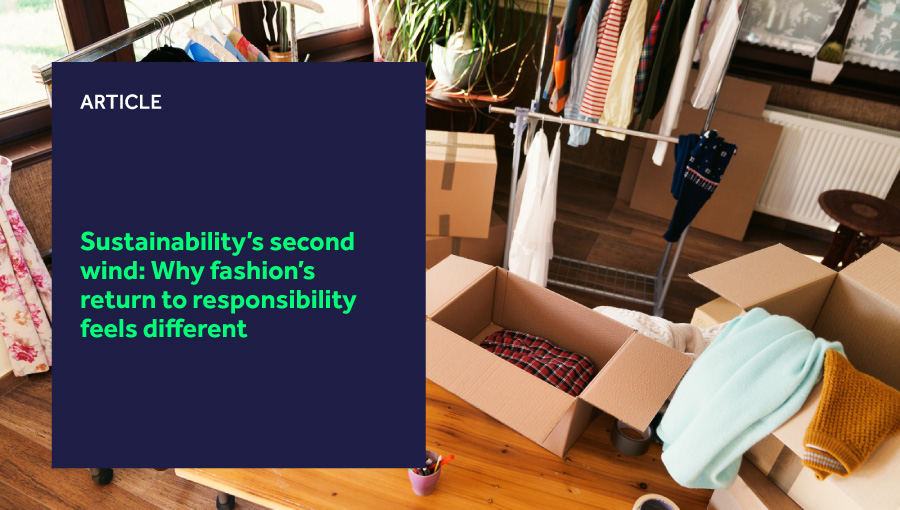
For more than a decade, fashion’s sustainability problem has been framed by the same hard truths: overproduction, overflowing landfills, supply chains opaque enough to hide a small nation, and a global waste footprint big enough to fill Sydney Harbour year after year.
Yet, it was only a few years ago that the oars rowed a course that seemed irreversible.
Sustainability was top of mind for everyone. Consumers and governments alike piled on the pressure. But then, all of a sudden, it fell sharply down global agendas as the full weight of the pandemic and geopolitical crises hit. CSR and ESG almost became mere afterthoughts.
As we head into 2026, however, sustainability is resurfacing in a way that feels different.
The renewed interest isn’t driven by a fresh wave of environmental evangelism alone. There is something more pragmatic afoot. Consumers are once again weighing longevity and durability, but now the reasoning is tied as much to value as it is to virtue.
Price pressures have pushed people to demand more from what they buy, and, in parallel, fashion’s cultural pendulum has swung back toward meaning and intention after a decade dominated by speed and growth at all costs. The mood has shifted.
People want products that hold their shape, their meaning, and their value.
That blend of financial pressure, cultural recalibration and environmental necessity is giving sustainability a second wind. The principles haven’t changed, but the incentives have.
This shift is perhaps most visible in resale.
McKinsey highlights that second-hand fashion is set to grow two to three times faster than the primary market through 2027, fuelled by customers hunting for value without compromising on self-expression or quality.
Where once resale carried stigma or novelty, it is now a default behaviour.
59% of consumers say they will turn to second-hand if tariffs rise further, yet more than 60% would continue shopping resale even if their budgets improved. This is an important detail. It confirms that resale’s momentum is not purely a reaction to economic strain.
People enjoy the hunt, the access and the sense of participation in a circular ecosystem that feels personal rather than performative. It is less about virtue signalling and outrage over fashion’s waste and more about meaningful engagement that aligns with their values.
The financial upside strengthens the appeal.
Certain pieces appreciate in value, as seen with Miu Miu’s Arcadie bag or Van Cleef & Arpels’ Alhambra collection. This logic ultimately compounds. People spend less, keep items in circulation longer, and can potentially sell them for a profit.
Sustainability, in this framing, isn’t a sacrifice. It’s a smarter way to engage with fashion.
Patagonia cut through the noise after releasing its 2025 progress report due to its consistent and refreshing take on sustainability. Refreshing might be a strange word to use here since Patagonia has maintained the same position since its launch. Yet it stood out compared to everyone else.
The report reinforced what the brand has always prioritised, that being durability, reparability, material integrity and environmental responsibility as part of everyday business.
It’s a great case study that shows what long-term commitment looks like when it is baked into product design, supply chain decisions and organisational behaviour. Though it must be stressed that while all brands could do better, Patagonia is the exception, not the template.
As a result of fashion’s continual race to the bottom, outsourcing labour and sourcing to remote countries to cut costs, today’s brands often face significant challenges in their supply chains.
Between multiple tiers, inconsistent documentation, and little incentive for upstream partners to disclose more than they must, brands, more often than not, cannot trace all of their own materials from end to end.
This opacity is one of fashion sustainability’s oldest bottlenecks. You cannot substantiate claims, verify, or even improve the ethical or environmental profile of something you cannot see.
With new EU regulations advancing toward mandatory product passports and stricter disclosure rules, the industry’s long-standing opacity is becoming increasingly untenable.
Patagonia’s example shows what is possible when the right mindset is employed at the start, but for most of the industry, it isn’t feasible to completely overhaul and rebuild their operations in this manner. It isn’t cost-effective, so it won’t happen, regardless of ethical or moral concerns.
For the rest of the industry, the path is less straightforward. This is where sustainability’s second wind becomes far more operational than ideological. If resale, longevity, and durability remain mainstream behaviours, brands need the infrastructure to support them.
Resale is a perfect illustration, especially for high-end items. You cannot validate authenticity at scale without structured product data and detailed lifecycle tracking. Nor can you guarantee provenance without some kind of serialisation.
Likewise, it is not possible to meaningfully extend a garment’s lifecycle without clear specifications, materials, certifications and care requirements that travel with it across systems, partners, and geographies.
The same applies to claims around ethical sourcing or material impact. Brands need item-level metadata that is consistent, auditable and linked directly to vendors and raw materials.
This is where structured CSR frameworks matter. Classifications, certificates and supporting documentation bring traceability out of inboxes, spreadsheets and legacy tools into a single environment where teams can actually understand the social and environmental impacts.
In the same vein, digital product passports will grow in importance as brands look to trace their materials and products more closely to improve their transparency and provenance efforts.
Microsoft Dynamics 365 Finance and Supply Chain Management already has serialisation support to help companies with this, and there are plenty of fashion-specific solution providers, K3 Fashion Solutions included, that will extend this functionality for clothing and textiles.
It’s important to stress, however, that none of these tools solve overproduction and waste on their own. But they do make progress possible by replacing opacity with clarity.
Sustainability is no longer being pushed solely by legislation or consumer outcry. Its momentum now comes from people actively participating in resale, which means brands have a commercial (not legislative) incentive to try harder.
That isn’t to say brands were right in letting sustainability slip down the agenda, but the net result is positive nonetheless. So long as these new consumer behaviours remain, there is a real chance of the industry at large making meaningful strides.
For fashion brands, this creates a different kind of mandate. Rather than sustainability being a communication exercise, brands need to build operational discipline through data, traceability, material insight and supply chain alignment.
However, challenges will persist. There’s still little incentive for suppliers and factories in remote countries to engage in such endeavours, but that is ultimately an issue for another day.
Any positive change is better than no change at all.
If you found this interesting and would like to know more about the options available to you today, like a CSR module, you can contact us for a no-obligation chat on how we can help.
 https://k3fashionsolutions.com/wp-content/uploads/2026/09/Inner-Circle-Award-blog-post-header.png
510
900
timjim
https://k3fashionsolutions.com/wp-content/uploads/2024/12/K3_Fashion_Solutions_Half-color_RGB.svg
timjim2026-09-11 14:51:282026-09-11 15:51:32K3 Fashion Solutions achieves the 2026-2027 Microsoft AI Business Solutions Inner Circle award
https://k3fashionsolutions.com/wp-content/uploads/2026/09/Inner-Circle-Award-blog-post-header.png
510
900
timjim
https://k3fashionsolutions.com/wp-content/uploads/2024/12/K3_Fashion_Solutions_Half-color_RGB.svg
timjim2026-09-11 14:51:282026-09-11 15:51:32K3 Fashion Solutions achieves the 2026-2027 Microsoft AI Business Solutions Inner Circle award https://k3fashionsolutions.com/wp-content/uploads/2026/08/dpp-problem-before-passport-featured-1.jpg
510
900
Jordan Heal
https://k3fashionsolutions.com/wp-content/uploads/2024/12/K3_Fashion_Solutions_Half-color_RGB.svg
Jordan Heal2026-08-11 09:41:102026-08-11 09:41:10The first step to DPP compliance isn’t actually the passport
https://k3fashionsolutions.com/wp-content/uploads/2026/08/dpp-problem-before-passport-featured-1.jpg
510
900
Jordan Heal
https://k3fashionsolutions.com/wp-content/uploads/2024/12/K3_Fashion_Solutions_Half-color_RGB.svg
Jordan Heal2026-08-11 09:41:102026-08-11 09:41:10The first step to DPP compliance isn’t actually the passport https://k3fashionsolutions.com/wp-content/uploads/2026/03/fashion-wholesale-rewritten-inventory-control-featured.jpg
510
900
Jordan Heal
https://k3fashionsolutions.com/wp-content/uploads/2024/12/K3_Fashion_Solutions_Half-color_RGB.svg
Jordan Heal2026-03-26 11:12:542026-06-30 13:26:42Why fashion wholesale is being rewritten around inventory control
https://k3fashionsolutions.com/wp-content/uploads/2026/03/fashion-wholesale-rewritten-inventory-control-featured.jpg
510
900
Jordan Heal
https://k3fashionsolutions.com/wp-content/uploads/2024/12/K3_Fashion_Solutions_Half-color_RGB.svg
Jordan Heal2026-03-26 11:12:542026-06-30 13:26:42Why fashion wholesale is being rewritten around inventory control
Solutions
Resources
Customers
About Us