How demand and supply optimisation helps fashion businesses manage inventory
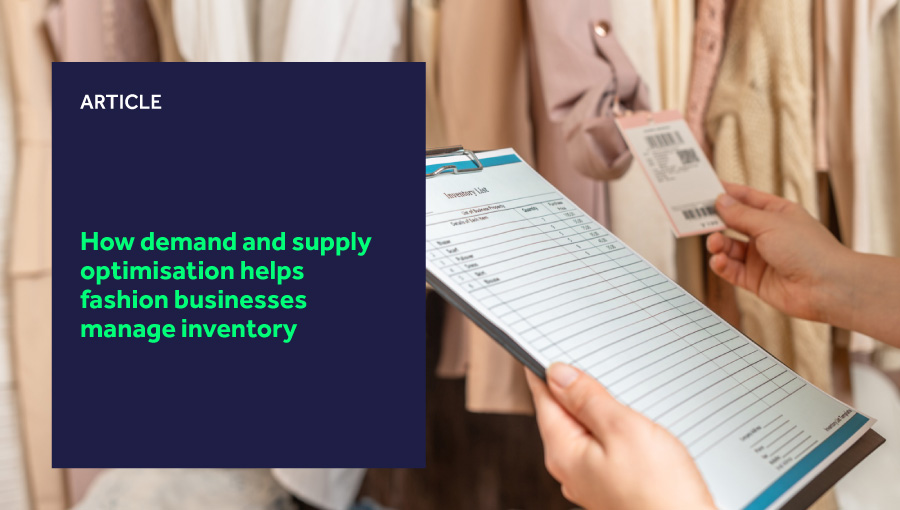
Coordinating sales demand against on-hand inventory and supply expected from incoming purchase orders across multiple channels is a significant challenge by itself, but without specialist functionality, it becomes a highly manual process that eats up valuable time.
Buying and customer service teams may default to inefficient workarounds and have to chase other departments, creating opportunities for critical information to be lost along the way.
A holistic view of demand and supply with correctly updated orders ensures that everyone has visibility, and that information flows naturally, allowing teams to better negotiate with suppliers and provide customers with the most up-to-date information.
Beyond that, the wider business also benefits from improved productivity, better commercial use of inventory, and reduced avoidable costs.
To make efficient use of inventory already available in a warehouse and stock due on an incoming purchase order, organisations need a way to coordinate both sources of supply against their existing and future commitments.
That level of coordination requires more depth than standard order management processes in ERPs may provide, particularly when supply and demand must be balanced across multiple markets and legal entities.
The absence of such capabilities could result in a system reserving physical inventory for later demand, even when an incoming purchase order is expected to arrive before the sales order needs to ship. The stock available then appears committed, limiting its use for nearer-term orders or other commercial requirements.
In larger enterprises where bulk purchasing is the norm, the issue can compound when purchase orders are created across channels or legal entities before the business knows which sales orders will ultimately consume the supply.
As sales demand becomes clearer, buying teams need to understand how those quantities should be distributed without repeatedly rebuilding the demand and supply picture manually.
Customer service teams depend on the same consistent, updated view to understand which incoming supply is expected to fulfil each order and when those goods can be expected. Without that shared view, the latest changes must be gathered from different teams before customers can receive accurate updates as to when their stock will be available.
Demand and Supply Optimisation tackles this disconnect within the orders themselves, soft-linking sales orders with the purchase orders expected to fulfil them. Shipping dates and priorities then determine whether demand needs on-hand inventory or supply still en route.
A soft link provisionally associates an order with expected incoming supply without creating a conventional, hard reservation against physical warehouse stock. This allows inventory already available to remain accessible for orders that need it sooner, provided the linked purchase order is expected to arrive, and the necessary handling can be completed before the later sales order must ship.
Such tools also support generic or bulk purchase orders created before their final destination is known. When future inventory is allocated to sales orders, the storage dimensions of relevant purchase orders can be updated to match the sales order storage dimensions, allowing businesses to create supply in bulk and align it with specific customers or channels once the intended allocation is known.
Teams can then calculate multiple scenarios before selecting the approach they wish to execute, giving them more information on potential cost implications, supplier deliveries, and the timelines communicated to customers.
Keeping later demand linked to future supply helps prevent physical inventory from being committed unnecessarily. Current stock remains available to sell or use elsewhere, while the later sales order retains an expected source of supply through the incoming purchase order.
This approach can reduce the risk of an artificial shortage in which sellable inventory appears unavailable because it has been reserved against an order due after replenishment is expected. It may also reduce missed sales opportunities in other channels and prevent teams from expediting inbound supply simply because current inventory appears fully committed.
Simultaneously, customer service teams can identify the purchase order expected to fulfil demand and communicate delivery dates with greater accuracy to their customers. Buyers can also assess alternative scenarios and their cost implications before negotiating with suppliers, giving them a stronger basis for discussing delivery changes and deciding whether expensive air freight is necessary.
Together, these capabilities can improve productivity across buying and customer service since they can better manage bulk purchase orders, update purchase orders in line with sales demand, and not have to repeatedly gather and reconcile information from other teams.
The value of such tools extends beyond productivity gains as they also reduce reliance on manual analysis or bespoke workarounds, while equipping the business with better cost information to support decisions about inbound and outbound goods flows.
The capabilities described in this article are directly supported by K3 Fashion, a specialist solution built inside Dynamics 365 Finance and Supply Chain Management.
Using Demand and Supply Optimisation, organisations can create soft links between their sales and purchase orders, with scenario calculations based on required shipping dates and business priorities to coordinate their sales demand against physical and future supply.
Buying and customer service teams can then work from the same demand and supply information, allowing them to focus more of their time on supplier and customer conversations. At the same time, the wider business benefits from stronger cost management, more effective use of available inventory, and clearer information about what customers can expect and when.
To find out more about how Demand and Supply Optimisation can support your business, fill out our contact form today and we’ll be in touch.
 https://k3fashionsolutions.com/wp-content/uploads/2026/07/nile-msft-featured.jpg
510
900
Jordan Heal
https://k3fashionsolutions.com/wp-content/uploads/2024/12/K3_Fashion_Solutions_Half-color_RGB.svg
Jordan Heal2026-07-10 13:08:522026-07-10 13:08:52NILE unifies retail, inventory and sustainability operations with Dynamics 365
 https://k3fashionsolutions.com/wp-content/uploads/2026/07/sanmar-msft-featured.jpg
510
900
Jordan Heal
https://k3fashionsolutions.com/wp-content/uploads/2024/12/K3_Fashion_Solutions_Half-color_RGB.svg
Jordan Heal2026-07-10 13:06:252026-07-10 13:06:25SanMar transforms its $2 billion wholesale apparel operations with Dynamics 365
 https://k3fashionsolutions.com/wp-content/uploads/2026/07/asos-msft-featured.jpg
510
900
Jordan Heal
https://k3fashionsolutions.com/wp-content/uploads/2024/12/K3_Fashion_Solutions_Half-color_RGB.svg
Jordan Heal2026-07-10 13:04:202026-07-10 13:04:20ASOS accelerates product development and decision-making with Microsoft AI

Solutions
Resources
Customers
About Us